

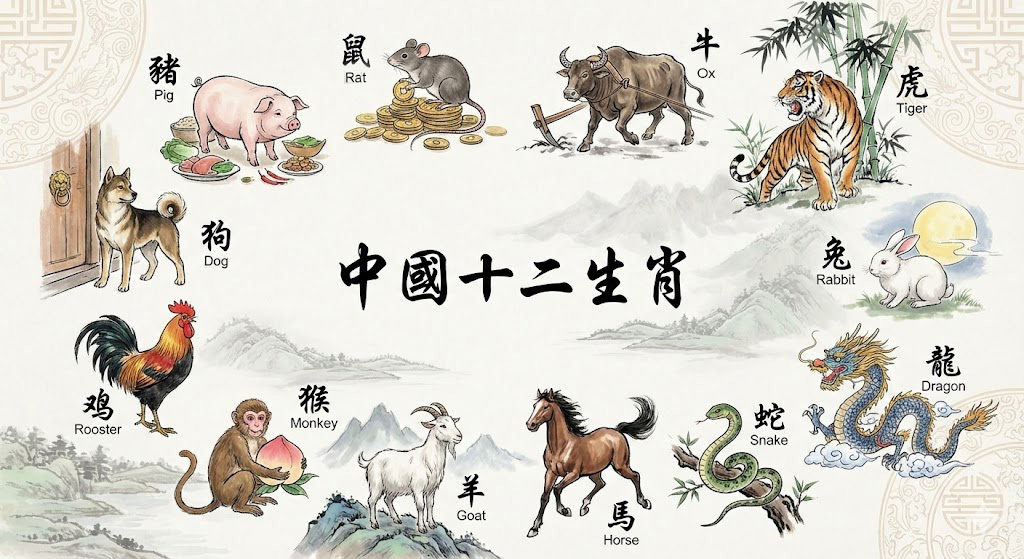
What is the Chinese Zodiac?
The Chinese Zodiac is a widely recognised aspect of traditional Chinese culture. Many people first encounter it through the animal associated with their birth year, or through the symbolism attached to a particular year, such as the Year of the Dragon or the Year of the Horse. For some, this is simply a cultural curiosity – something fun to notice and enjoy. For others, the zodiac offers a framework for reflecting on personal tendencies, relationships, and the cyclical patterns of energy we find in nature and in life.
This article is intended as a brief introduction to what the Chinese Zodiac is, where it comes from, and why it has been used for so long. Rather than approaching it in a mystical or predictive way, we will look at it as a practical symbolic system that grew out of close observation of natural cycles and human experience.
The Chinese Zodiac as Part of Chinese Culture
At its most basic level, the Chinese Zodiac is a cultural timekeeping system. It has been used for centuries to mark years, organise calendars, and provide a shared symbolic language for talking about time and change. In the same way that the Gregorian calendar uses months named after Roman gods or numbered weeks to structure our year, the Chinese Zodiac uses animals and elements to label different periods of time as well as to describe the patterns of qualities that might be expected to occur within them.
Because of this, it can be engaged with on many levels. You can enjoy it casually, as a cultural tradition that adds colour and character to the passing of years. You can also use it as a reflective tool, a way of thinking about how certain themes may be more prominent at particular times, or how your own tendencies might interact with the world around you.
Energy Moves in Cycles
A key idea underlying the Chinese Zodiac is that energy moves in cycles. This is not a uniquely Chinese idea; it is something we can observe almost everywhere once we start looking for it.

At a very small scale, we see cycles in the oscillation of a string on a musical instrument, or in the movement of electrons around the nucleus of an atom. At a much larger scale, we see cycles in the movement of the moon, the planets, and the stars. On a human scale, we live inside cycles every day: waking and sleeping, light and darkness, activity and rest.
The seasons provide one of the clearest examples. Spring brings growth and outward movement. Summer is expansive and expressive. Autumn gathers and consolidates. Winter stores and rests. These phases repeat year after year, and most of us instinctively adjust our behaviour to them, even if we never consciously think about why.
Traditional Chinese thought takes this observation seriously. Rather than seeing time as a flat, uniform line, it views time as rhythmic and textured. Different moments carry different qualities, and those qualities influence what actions are easier, more effective, or more costly.
Harmonising with the Cycle
Once we recognise that energy moves in cycles, the next step is practical: if we understand where we are in a cycle, we can make better choices.
On a very simple level, this is obvious. If we know it will soon get dark, we make sure we are on our way home. If we know winter is approaching, we prepare warmer clothing or store food. If we know spring is coming, we plan planting so that seeds go into the ground at the right time.
In each case, the key is not forcing our will against the environment, but working with it. We do not argue with nightfall or demand that seeds sprout in frozen soil. We observe the conditions and respond intelligently.

The Chinese Zodiac extends this principle beyond daily and seasonal cycles to longer arcs of time. It suggests that years, like seasons, have characteristic qualities. By understanding those qualities, we can better align our plans, expectations, and efforts with the prevailing flow of energy.
From Simple Cycles to Subtle Patterns
While the basic idea of cycles is straightforward, reality is rich and nuanced. Energy does not move in only one smooth wave. Multiple cycles overlap, interact, and influence one another.
For example, the cycle of day and night continues regardless of the season, but its expression changes. A summer day feels very different from a winter day, even though both contain light and darkness. Similarly, personal cycles—such as stages of life or periods of learning—interact with broader social and environmental cycles.
The Chinese Zodiac arose as a way of recognising and organising these layered patterns. Instead of trying to describe the energy of these patterns in concrete definitive terms, it uses symbolism to capture the qualities of different phases in an accessible and memorable way.
Animals and elements are not chosen because they are literally causing events, but because their characteristics provide a useful language for describing tendencies, moods, and directions of movement within a larger cycle.
The Twelve Animals
One half of the Chinese Zodiac system is made up of twelve animals. These animals repeat in the same order every twelve years: Rat, Ox, Tiger, Rabbit, Dragon, Snake, Horse, Goat (or Sheep), Monkey, Rooster, Dog, Pig.
Each animal represents a set of qualities that have been observed and distilled over time. For example, the Rat is often associated with resourcefulness and adaptability, while the Ox is linked with steadiness and perseverance. These qualities are not moral judgements, nor are they meant to describe individuals in a simplistic way. Instead, they highlight certain tendencies that may be more visible during that phase of the cycle.
When applied to years, the animal gives a broad sense of the character of that time. When applied to a person’s birth year, it offers a lens for reflecting on innate patterns—how someone might naturally approach challenges, opportunities, or relationships.
The Five Elements

The second half of the system is the Five Elements, also sometimes called the Five Phases: Water, Wood, Fire, Earth, Metal
These are not elements in the modern chemical sense. Rather, they are archetypal phases of energy transformation. Each one describes a particular mode of movement and change.
- Water is associated with storage, depth, and potential.
- Wood relates to growth, direction, and activation.
- Fire expresses expansion, warmth, and transformation.
- Earth represents stability, integration, and nourishment.
- Metal is connected with structure, clarity, and refinement.
The Five Elements also move in a cycle, generating and moderating one another. This framework is used throughout traditional Chinese thought, including medicine, martial arts, and qigong, because it provides a clear way of understanding how change unfolds over time.
A Sixty-Year Cycle
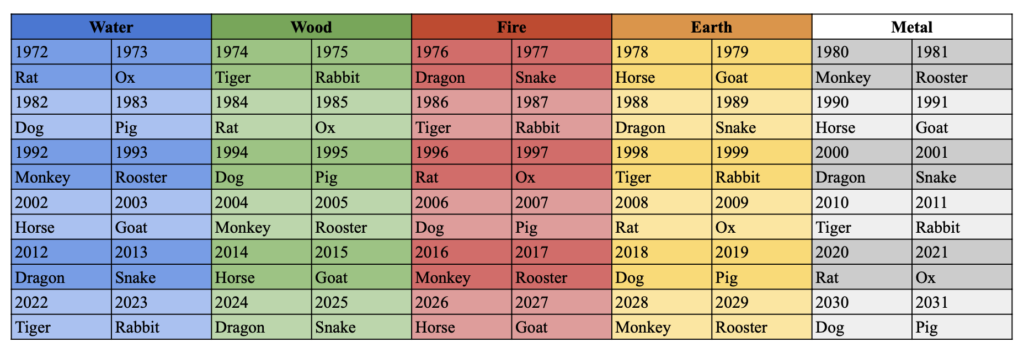
When the twelve animals and five elements are combined, they form a larger repeating cycle of sixty years. Each year is defined by both an animal and an element, such as a Water Rabbit or a Fire Horse.
This means that while a Horse year occurs every twelve years, a Fire Horse year occurs only once every sixty years. The element adds nuance and specificity to the animal’s qualities, much like how a season feels different depending on the specific weather conditions within it.
This layered structure allows the Chinese Zodiac to describe the complexities of what we experience with the passing years with more precision than a single repeating symbol could offer on its own.
Lunar New Year
Each Chinese Zodiac year begins on the 2nd new moon after the winter solstice rather than on January 1st as in the Gregorian calendar (the calendar most of the world uses day to day). This gives a different tone to the idea of when the year starts.
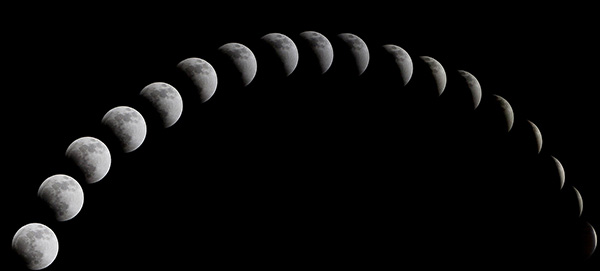
January 1st is shortly after the winter solstice, the days have only barely started to get ever so slightly longer, and the overall energy of the environment is very yin and still. It continues to be a time of rest and inward reflection. The Chinese New Year on the other hand is a month or more later, at the very start of the stirrings of new growth in the environment as the energy starts to transition from winter to the rising energy of spring. This is when the energy of the year starts to truly take on its new character and it flows into action.
Winter can be used to reflect, ponder, and prepare, and then in the Chinese new year we can start to plan and take action!
Chinese Zodiac Year Table
The following table shows a full 60 year cycle of the Chinese Zodiac so you can see the pattern of how the animals and elements combine over time and identify the animal and element associated with any given year.
If you are interested in a year outside this range, you can easily extend this same pattern or use a Chinese Zodiac year calculator like this one.
Using the Zodiac to Understand a Year
One of the traditional uses of the Chinese Zodiac is to reflect on the general qualities of an upcoming year. This does not mean predicting specific events, but rather understanding what kinds of activities may be more supported, and what kinds may require more care.
For example, some years emphasise movement and change, making them suitable for new projects and exploration. Others favour consolidation, reflection, or long-term planning. By recognising these tendencies, we can adjust our expectations and strategies accordingly.
This approach is especially useful when making decisions that unfold over time. Instead of pushing blindly forward, we can ask how our plans fit within the broader energetic climate, and make small adjustments that increase the likelihood of harmonious outcomes.
The Zodiac and Personal Insight
The year we are born in also leaves an imprint on us. Again, this is not about rigid categorisation or limitation. No single symbol can fully describe a human being.
However, understanding the animal and element of your birth year can offer a starting point for self-reflection. It may highlight certain strengths that come easily to you, as well as challenges that recur throughout your life. Seen in this way, the zodiac becomes less about labelling and more about awareness.
When used skilfully, this kind of insight can help us play to our strengths, work more patiently with our weaknesses, and better understand differences between ourselves and others.
Culture, Curiosity, and Exploration
Whether you approach the Chinese Zodiac as a cultural tradition, a symbolic language, or a reflective tool, it offers a rich field for exploration. The stories, images, and associations connected with the animals and elements have developed over centuries, and continue to be reinterpreted today.
This article is intended as an introduction to the Chinese Zodiac: what it is, why it exists, and how it has traditionally been used. It is not meant to provide an exhaustive analysis of every animal and element combination, each of which could be studied in great depth.
If you are interested in understanding more about the energy of the coming year of the Fire Horse in 2026, you can check out our article here.
1 Comment. Leave new
I was born in the year of the Goat (Ram). I’m looking forward to the year of the Fire Horse.