


What is Mindfulness?
Mindfulness means to pay attention to the present moment without judgement, by focusing on your thoughts, feelings, and bodily sensations. It means to be fully engaged in your present experience, rather than dwelling on the past, or worrying about the future. While many ancient traditions included practices for being mindful, the value of mindfulness has been recognized more and more in recent years, so much so that a modern movement has emerged with its own approach and methods for developing this state. Mindfulness has even become a bit of a buzzword in some mental health, wellbeing, and even business and high performance circles.

Our minds are very powerful, directing the flow of our energy and many of the functions of our bodies both consciously and unconsciously. When our minds are busy thinking about what has occurred in the past, or what may or may not occur in the future, our energy naturally flows to these scenarios, and to some degree our bodies respond as if those things were actually occurring in the present moment. For example if our mind dwells on an argument that we may have been involved with in the past, or possibly even one that hasn’t happened yet, but we think may happen in the future, then to a greater or lesser degree our body will respond as if it is actually happening. Our body will release hormones related to our response to the stimulus of the argument, perhaps adrenalin and cortisol. It is likely that our blood pressure will rise, and we may build and hold tension in key muscles in our body such as our neck and shoulders as a way to protect ourselves in case the conflict escalates from verbal to physical. Conversely, when our mind dwells on something pleasant, such as an enjoyable time we had relaxing at the beach, an achievement from our past, or time spent with a loved one, our body will have other physical responses in the present moment. Instead of building and holding muscles tensions we may release them. Our posture may change to reflect the positive emotions we are recalling and re-experiencing to some degree, and we will release other hormones such as serotonin, dopamine, or oxytocin depending on the particular experience our mind is focused on.
Benefits of Mindfulness
While it is clear in the examples above that one of these sets of responses is likely to be more beneficial to our health and wellbeing than the other, both of them are still directing the responses and resources away from what is actually going on within it. When instead of focusing on what has occurred in the past, or on some hypothetical future that may or may not exist, we simply focus our mind on our present experience, our bodies resources are directed towards what is actually going on within us at that moment. Our bodies energy can then be used most effectively to support us in dealing with our current situation, and it is more likely that resources will be used for important functions such as healing and repair, rather than being directed towards hypotheticals where they may give no benefit.

Studies have shown that doing practices to enhance mindfulness can bring a wide range of benefits for both mental and physical health including reduced stress and anxiety, better emotional regulation, enhanced cognitive functions like memory and attention, better quality sleep, and even improved relationships. The direct physical benefits can be impressive including lower blood pressure and improved cardiovascular health, better management of chronic pain, and a stronger immune system.
How Qigong is a Powerful Tool for Becoming Mindful
While there are many methods and practices for becoming more mindful of our present experience, the practice of qigong is a particularly powerful tool for becoming more skilled at entering and maintaining this state of awareness.
Embodiment
Qigong is an embodied practice, meaning that it makes direct use of our physical body as a way for us to work with many aspects of our functioning. Within qigong we use physical movements and postures that naturally stimulate deeper functions within us and draw our attention towards them. Having the physical part of the practice often makes it easier to bring our awareness more fully to our current experience. If at first we find it hard to tune in fully to our experience, if we just do the movements, or spend time within the postures, our attention will naturally go to our physical sensations to at least some degree, and as we persist it becomes easier and easier to notice more of what is going on within us during the current moment, and to release our focus on other things.

Breath
Qigong also makes extensive use of our breath. Our breath acts as a valuable bridge between our conscious and unconscious awareness because it is the one function of our internal organs that is easily influenced either consciously or unconsciously. If you don’t think about it at all, your breath will generally continue in the background without any particular conscious awareness necessary, but if you choose to you can also easily change how your breathe – breathing slower, faster, deeper, or more shallow, and so on. As the patterns of our breath change the pressures and tensions within our bodies, and the chemistry of our blood, this has a flow on effect to the functioning of all the rest of our internal organs as well. And so by observing and working consciously with our breath we can more easily tune into and affect many aspects of our functioning that we would normally have very little conscious awareness of – leader to a much deeper awareness of our current experience.
Framework of Understanding
The philosophical underpinnings of qigong, and its connection with the knowledge of Chinese medicine also gives us a framework to understand aspects of what we observe more clearly. For example Chinese medicine recognizes the connection between different emotions and the function of different organs. For example the emotion of fear has a strong connection to the release of adrenaline from the glands that sit directly about the kidneys, and further the stimulation of this emotion also affects the tensions and postures of our body due to its effect on the meridian pathways in the body. This means that our observations of what is going on physically within our bodies – the activity and sensations of our organs, tensions in our muscles, and the postures we find ourselves assuming or holding, give us feedback on the emotions that we are also experiencing and become a valuable tool for deeper self knowledge. It is quite an interesting reversal of how we normally think about things when we understand that we can become aware of emotions that we didn’t realize we are experiencing through our observation of our own mind. It helps us to much more clearly recognize the embodied nature of our experience of life and get out of just being stuck within the thoughts in our heads.
Versatility
Another benefit of qigong is that it is so versatile! There are such a wide variety of practices which can be suitable for different people in different circumstances and for different purposes. Many qigong practices are slow and gentle, but there are also some which are quite dynamic and vigorous, and these will appeal to different people for different reasons. Many practices can easily be done either standing, sitting, or even lying down according to someone’s physical capacity. There are practices that you can do easily within just a few minutes, or practices that you can become absorbed in for hours on end – which will be useful in different situations. And there are also many practices that can be used to focus in on just one particular area of awareness that someone may be interested in exploring when they have a specific issue they would like to address.
Focus on Living Energy
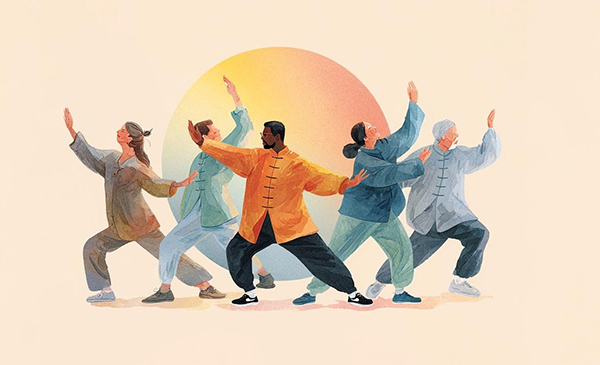
Qigong practices have one more characteristic that make them particularly useful for developing mindfulness. At any given moment we have a myriad of different functions going on within our body, and countless factors affecting us externally. Far too many for us to consciously recognize and process within our awareness individually. So if we were to try to be aware of each of these parts of our experience individually in order to be truly mindful of our complete current experience, we would need to be constantly moving our conscious awareness from one thing to another – and even there are far too many for us to possibly be aware of all of them. In qigong we have a different way of becoming conscious of our current experience. Instead of focusing on individual parts we focus on our living energy, which flows as the sum total of all of these functions and influences. This lens of consciousness focus on our perception of our living energy, makes qigong a particularly powerful tool for developing a more complete mindful awareness of our current experience.
Conclusion
So all of these aspects of qigong – the embodied nature of the practice, extensive use of the breath, it’s insightful philosophical framework, its versatility and ease of application by people of all abilities, and its focus on our living energy make qigong and excellent tool for becoming more mindful and experiencing all of the benefits that come from this!
If you would like to explore how qigong can help you become more mindful, an excellent place to start is our FREE Introduction to Qigong Theory and Practice course which you can find here. There are also a range of free qigong videos that you can follow along with to get a taste of qigong which you can find here. If you want to go deeper, you might like to check out our livestreaming qigong classes which you can find here, or our very comprehensive qigong instructor certification courses here.
2 Comments. Leave new
I love your blogs about qigong and fine them so very useful in my practice. Thank you for doing this and the time it takes to write them. 🙏
I’m glad you enjoy them 😊